
PRRS
Porcine Reproductive and Respiratory Syndrome – and Scotland’s national programme to control and eliminate it.
PRRS Control & Elimination Scotland (PCES)
PCES is an industry-led programme, supported by the Scottish Government, working towards the eventual eradication of PRRS from Scotland. It is managed by Scottish Pigs with Quality Meat Scotland, SRUC, pig producers and their vets.
 What is PRRS?
PRRS is widely considered one of the most economically significant diseases of pigs in Scotland. The PRRS virus causes:
- Reproductive failure in sows and gilts – abortions, stillbirths, infertility and piglet deaths
- Respiratory disease in growing pigs – pneumonia
- Immune suppression – leaving pigs open to other infections, thereby increasing antibiotic use
The virus spreads very easily, even over distance. That makes biosecurity central to controlling it.
Top 10 PRRS biosecurity risk areas
Recognise the risks. Keep PRRS out! The risk areas are listed from highest to lowest risk.

Not doing anything about your farm biosecurity! Make sure everyone follows the Farm Biosecurity Plan rules. Keep checking and improving your biosecurity risk management.
Strictly quarantine incoming stock (6–8 weeks) with no contact with the main farm, and test before introduction.

Maintain “dirty” and “clean” area separation (the line of separation) and avoid vehicles entering the clean area – especially any that have visited other farms. Any farm vehicle that has to enter the clean area must be thoroughly cleaned and disinfected first, including wheel washing.

Trucks must stay outside the farm clean area. Farm staff must not enter the truck, and hauliers must not enter the farm clean area. Any outbound pig that has had contact with the truck must not be allowed back onto the farm.

Make sure all visitors and staff obey the farm’s pig-free requirements. Maintain “dirty” and “clean” area separation, and only enter the clean area through the designated hygiene lock or Danish entry. Sign the visitors book every time.

Only allow new or thoroughly disinfected equipment onto the unit, through a single controlled entry point.
Make sure feed deliveries follow the farm’s biosecurity rules. Keep delivery vehicles out of clean areas, and only use your own farm-specific feed pipes.
Keep all pig buildings, feed bins and stores bird-proofed.
Although not a specific risk for PRRS, keep wild animals and pets out, and maintain a thorough rodent control plan.
Respect the 5 km minimum distance between pig units – including when spreading slurry.
Cost of PRRS
Why control PRRS?
Controlling PRRS brings benefits well beyond the disease itself:
- Better pig health and welfare
- Better production efficiency and lower cost of production
- Lower greenhouse gas emissions per kg of pork produced
- Less antibiotic use
- Better biosecurity means better protection against other diseases, such as swine dysentery, enzootic pneumonia and African Swine Fever
From pilot to national programme
-
2018
Industry agrees a plan
Scottish pig industry stakeholders came together to plan how to control PRRS in Scotland, building on QMS serological surveys and existing disease mapping.
-
2019 – 2020
Moray Coast pilot
A Knowledge Transfer and Innovation Fund (KTIF) funded pilot targeted the Moray Coast. The area had few PRRS-positive units, and many Scottish pig movements start there, so controlling disease at source would help herds downstream. All the positive units took part, with their vets. Biosecurity events brought together producers, hauliers, processors, feed companies and government.
Result: the Moray Coast became almost free of PRRS, with one remaining unit controlling it through vaccination. The pilot proved that area control of PRRS is possible in Scotland.
-
2024 – 2025
PCES Year 1 – building the foundations
With Scottish Government funding, the PRRS Control & Elimination Scotland (PCES) programme set out to test every pig unit in the country, audit biosecurity on farm, and map PRRS-positive units. More than 160 farms joined the testing programme, and a new herd categorisation system was introduced (see below). Regional producer meetings in March 2025 showed strong interest in producer-led regional groups.
-
2025 – 2026
PCES Year 2 – testing, audits and regional groups
- 94 biosecurity audits completed, most of them repeat visits. Two-thirds of Scottish units have now been audited, and 42% have been audited twice.
- 55% of re-audited units improved their overall biosecurity score.
- Four producer-led Regional Strategy Groups set up: North, Aberdeenshire, Angus & Fife, and South.
- Biosecurity audits with hauliers, and extra lorry washing support at the Brechin abattoir, the busiest point in the Scottish pig supply chain.
- African Swine Fever contingency planning workshops for producers and vets.
-
2026 – 2027 · now
PCES Year 3 – working towards eradication
- A focus on the Regional Strategy Groups and their plans to improve regional PRRS status
- Continued annual testing of all Scottish herds to establish current PRRS status
- PRRS mapping in SPHN, developed by SRUC and Scottish Pigs, launched ahead of the Regional Strategy Group meetings for producers who have signed the Scottish Pig Health Charter, and their nominated vets
- A PRRS warning added to the ScotEID pig movement system, to discourage moving PRRS-positive pigs into negative areas
- A cleansing and disinfection technician at the Brechin abattoir to improve and monitor lorry cleanliness and disinfection
- Distribution of training and on-farm materials, and meetings on biosecurity
- A feasibility study into online visitor records for farms
PRRS herd categories
Every unit in the programme is given a PRRS status category, reflecting both the presence or absence of PRRS virus and vaccination status. If breeding and growing pigs on the same unit have different statuses, the higher number is used.
| Category | Breeding pigs (B-F, B-W, B) | Growing pigs (W, W-F, F) |
|---|---|---|
| 1 | Negative / not vaccinated | Negative / not vaccinated |
| 2 | Positive / vaccinated sows / weaning negative piglets | Not applicable |
| 3 | Positive / vaccinated | Positive / vaccinated |
| 4 | Positive / not vaccinated | Positive / not vaccinated |
| 5 | Unknown | Unknown |
B = breeding, B-F = farrow-to-finish, B-W = breeder-weaner, W = weaner, W-F = wean-to-finish, F = finisher.
Where Scotland stands
Status of units tested in 2025–26 (PCES Year 2 report). Out of all the units tested (69% of all Scottish herds), more than half were negative / not vaccinating.
| Category | Units | % |
|---|---|---|
| 1 Negative / not vaccinated | 73 | 35% |
| 2 Negative weaners / vaccinated sows | 27 | 13% |
| 3 Positive / vaccinated | 32 | 15% |
| 4 Positive / not vaccinated | 12 | 7% |
| 5 Unknown | 65 | 31% |
All PRRS-positive herds with breeding pigs are already vaccinating their sows, and most are weaning PRRS-negative piglets. Reducing the number of “unknown” units, especially in the South East, is a priority.
Taking part
Producers
- Test at least once a year. Annual testing is the minimum needed to keep the PCES map up to date. Please keep submitting samples.
- Get a biosecurity audit. Your herd vet can complete a Biocheck.UGent audit with you. It shows how your unit compares and where to improve.
- Join your Regional Strategy Group. These producer-chaired groups plan local PRRS control. To find out which group covers your area, contact andy@scottishpigs.org.uk.
- Register for the mapping tool (SPHN). Producers who have signed the Scottish Pig Health Charter register with SRUC for a unique username and password, and nominate their herd vet. See SPHN member access.
Vets: recommended testing protocols
Ear blood swabs are pooled (e.g. 30 samples tested as 6 pools). DTW = day-to-wean piglets; woa = weeks of age.
| Herd type | Vaccination status | Samples | Test |
|---|---|---|---|
| Farrow-to-finish | Not vaccinated | 10 slaughter bloods | ELISA |
| Sows only | 10 slaughter bloods, plus 30 (6) DTW ear blood swabs for breeding herd stability | ELISA / PCR | |
| Piglets (or sows & piglets) | 30 end-nursery bloods (12 woa)* | PCR | |
| Breeding herd | Not vaccinated | 30 P1 & P2 sow bloods (preferred). Optionally 30 (6) DTW ear blood swabs – if negative, also test sow bloods by ELISA | ELISA / PCR |
| Sows only | 30 (6) DTW ear blood swabs (if piglets are also vaccinated, a differential PCR is needed) | PCR | |
| Breeder-weaner | Not vaccinated | 30 P1 & P2 sow bloods | ELISA |
| Sows and/or piglets | 30 (6) end-nursery bloods (12 woa)* | PCR | |
| Nursery / grower | Not vaccinated | 10 end-nursery bloods (12 woa) | ELISA |
| Piglets vaccinated | 30 (6) end-nursery bloods (12 woa)* | PCR | |
| Wean-to-finish | Not vaccinated | 10 slaughter / finisher bloods | ELISA |
| Piglets vaccinated | 30 (6) end-nursery bloods (12 woa)*, plus 10 finisher bloods at 16 woa (test only if nursery bloods negative) | PCR | |
| Grow / finish | Not vaccinated | 10 slaughter / finisher bloods | ELISA |
| Piglets vaccinated | 10 finisher bloods at 16 woa | PCR |
* Until a differential PCR is available, leave at least 8 weeks after vaccination before sampling.
Points of contact
vet@scottishpigs.org.uk
andy@scottishpigs.org.uk
Signs and training materials
PCES has produced signs, posters and training materials to help put good biosecurity into practice on farm. For the practical measures they support, see our Biosecurity page.
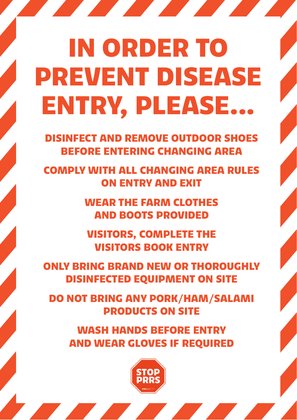 Farm entry signA3“In order to prevent disease entry, please…” – the rules for everyone arriving on the unit.
 Car park sign297 × 180 mm, yellow, blue or red“No vehicles beyond this point”, with a phone number to call on arrival.
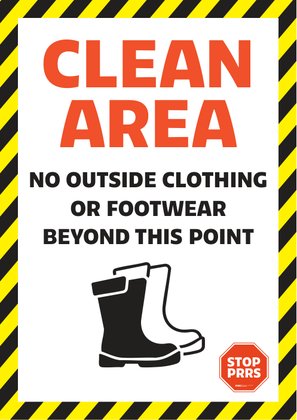 Clean area signA4“No outside clothing or footwear beyond this point.”
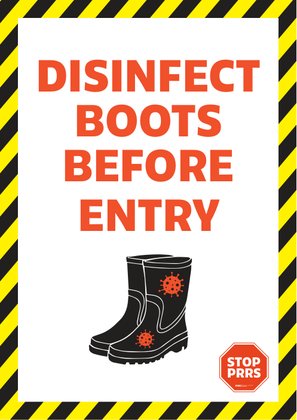 Disinfect boots signA4“Disinfect boots before entry.”
 Hand washing signA4, red or blue“Please wash your hands.”
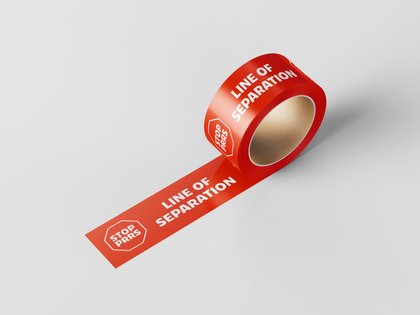 Line of separation tapeRollMark the line between the clean and dirty sides of your unit.
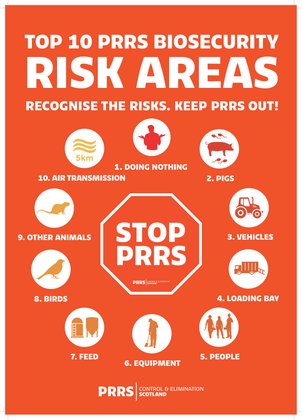 Top 10 risk areas posterA3The ten PRRS biosecurity risk areas at a glance.
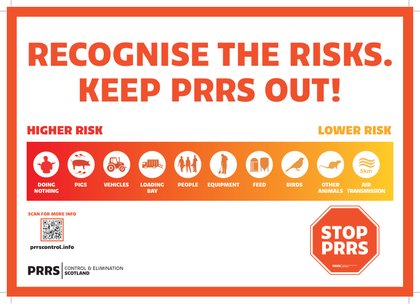 “Recognise the risks” posterLandscapeThe Top 10 risk areas, from higher to lower risk.
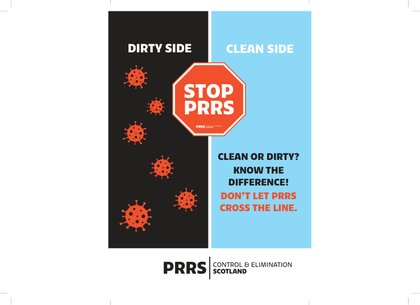 “Clean or dirty?” flyerA5 gatefoldExplains the line of separation and the Top 10 risk areas.
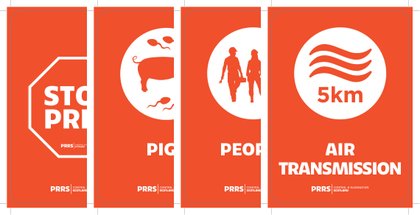 Pairs cardsA6 card setA matching-pairs card game for training farm teams on the Top 10 risk areas.
All of these are available to order from vet@scottishpigs.org.uk. Please say which items you would like, how many, and your delivery address.
Partners and funding
PCES is funded by the Scottish Government and delivered by Scottish Pigs (previously called Wholesome Pigs (Scotland) Ltd) with Quality Meat Scotland, SRUC, WD Strachan Veterinary Services, GW Pig Services and Biocheck.UGent. The Moray Coast pilot was funded through the Knowledge Transfer and Innovation Fund (KTIF), with GW Pig Consulting, SRUC, SAC Consulting and QMS. Thanks to all the producers, vets and practices taking part.
This programme is supported by funding from the Scottish Government.